The USA Hockey Development League, which many clubs and parents call the National Development League or NDL, is a new top tier of American youth hockey that starts in the 2027-28 season. USA Hockey chose 29 programs in 19 states from more than 80 applicants, and each will field one 15U team and one 17U team, 58 teams in all. Teams play 40 to 55 games from September to March, at least 60 percent of them against each other, then their own playoff instead of USA Hockey Nationals. Signing starts early: January 15, 2027 for a program's returning players and February 1 for everyone else. Each team may carry two non-American skaters, and every goalie must be a US citizen.
Ask ten American hockey parents where the best 15-year-olds play and you will get ten answers. USA Hockey's own development staff said as much. "There was no real clear direction for the top 2 percent of players in the United States," Bob Mancini, the federation's assistant executive director of hockey development, said on the day the answer arrived, in remarks reported by the Boston Globe. That day was October 5, 2026, when USA Hockey named the 29 programs of its new Development League, the tier many clubs and parents already call the NDL. Two days later all 29 had accepted.
The league does not play a game until September 2027, but the decisions start much sooner: the first signing window opens on January 15, 2027, before most families will have seen a fee sheet. This guide puts the league in one place: what it is and what to call it, the 29 programs and where they are, which birth years play 15U and 17U, how the season, the signing calendar and the Player Agreement work, what it costs, what the rules mean for a Canadian player, and what happens to the hockey around it. The facts come from USA Hockey's own guidebook, rulebook and announcements. Where we rely on reporting that USA Hockey has not confirmed, we say so.
- Your player is at one of the 29 programs now. Read the January 15 signing window and what a Player Agreement commits you to.
- He plays Tier 1 somewhere else. Read how to get on an NDL team and what happens to Tier 1.
- You are a Canadian family. Read who can play and who cannot.
- He is a goalie, or he is 14. Read the age and roster limits.
- You are weighing it against prep school or staying home. Read the four routes side by side.
Last reviewed November 24, 2026. We update this guide as USA Hockey and the programs announce more. Print the one-page family checklist (PDF).
- November 24. The Madison Capitols name Justin Friedman general manager and director of their DL teams. Thirteen of the 29 programs have now named DL staff; the full list is below. The Northeast Pack adds the Florida Surf, a Tier 1 club that is not in the DL, at 13O and 14U for 2027-28.
- November 21. The Jr. Coyotes name the leadership of their DL teams: Ron Filion as general manager, Mike DeAngelis as vice president of hockey operations and Jordan Muzzillo as assistant general manager.
- November 18. Pittsburgh Penguins Elite name their DL coaches: Dan Mayes at 17U and Jerry Freismuth at 15U.
- November 17. USA Hockey holds its November call with the 29 programs. Reported outcomes: target dates of March 12 to 18, 2028 for the first championships, a league showcase in Rochester, New York in the second week of September 2027, three 20-minute periods in every game in the United States, and a January vote on opening Tier 1 tryouts later. The next call is set for December 15. USA Hockey has confirmed none of it.
- November 16. The Anaheim Jr. Ducks name their NDL staff: Alex Kim as general manager and 17U coach, Cory Kane as 15U coach and Craig Johnson as director of coaches.
- November 13. The Atlantic Youth Hockey League adds the Rockets and the Wolfpack for 2027-28, so all four DL programs in USA Hockey's Atlantic District will be part of that league.
- November 4. The Northeast Pack publishes its 2027-28 dates: five showcases from September 2027 to January 2028, then playoffs in Rochester, New York on February 18 to 21, 2028.
- October 28. The Northeast Pack names Okanagan Hockey Colorado its guest organization at 15U DL and 17U DL for 2027-28. Chicago Mission names its DL coaches: Joe Caprio at 17U and John Doherty at 15U.
- October 27. The Buffalo Jr. Sabres name their first DL coaches: Jason Nightingale at 17U and Jacob Brozyna at 15U. The Ohio Blue Jackets name Ed Gingher general manager, Cam Atkinson associate general manager and Josh Harrold 15U coach, and the Colorado Thunderbirds name Ryan Seavy general manager and 17U coach and Mike Davies 15U coach.
- October 22. Clanko Media reports on USA Hockey's first call with the programs, held that week. Reported outcomes: a first championship near Detroit in mid-March 2028, scores but no official standings, and no high school teams on the side.
- October 19. The Philadelphia Jr. Flyers name Rocky Russo general manager and 15U coach and Jon Rogger 17U coach. The Boston Jr. Eagles join the Northeast Pack's DL divisions.
- October 7. All 29 programs accept their invitations. Little Caesars commits its DL teams to the Northeast Pack.
- October 6. Minnesota Hockey announces its own answer: fall high performance teams of 15s and 17s for Minnesota residents.
- October 5. USA Hockey names the 29 programs and appoints Scott Paluch commissioner.
What Is the USA Hockey Development League (the NDL)?
It is a national group of 29 youth hockey programs, chosen by USA Hockey, that will each run one 15U team and one 17U team under a common set of development rules starting in the 2027-28 season. USA Hockey's league page calls it "a national framework of high-performance youth hockey programs," and the federation's own FAQ is blunt that it "will not be a league in the traditional sense." There is no central schedule and no league office setting prices. Each program hires its own coaches, sets its own fees and builds its own schedule, inside rules that USA Hockey writes and enforces.
The USA Hockey Congress approved the league at the federation's Winter Meeting in Nashville, which concluded on January 18, 2026. It now sits in Section III.J of USA Hockey's Rules and Regulations, and a separate Development League Guidebook for 2027-28 is the binding authority on who can play, how players are signed and how teams must operate. USA Hockey presents it as the third big step in American player development, after the National Team Development Program in 1996 and the American Development Model in 2009.
The stated aim is narrow. The league is "designed to include the top 2% of 15U and 17U youth hockey players in the United States," and its job is to get them ready for junior hockey in the USHL and NAHL, for the national teams, and for college and pro hockey after that. The guidebook's own summary of the philosophy: "Winning will be evaluated; learning will be celebrated."
Day to day it is run by a commissioner, Scott Paluch, USA Hockey's director of player development and a former head coach at Bowling Green and assistant at Boston College. Erin Mensay, USA Hockey's manager of member services, is the registrar who approves every roster and player move. Above them sits a nine-member joint subcommittee of USA Hockey's Player Development Committee and Youth Council, co-chaired by vice presidents Kris Knauss and Keith Barrett, which picks the programs, sets the fees the programs pay and can put a program on probation or remove it.
Two things the league is not. It is not a replacement for Tier 1: USA Hockey says it is "designed to work in cooperation with Tier I hockey," and Tier 1 teams, leagues and national championships all continue. And it is boys' hockey only. USA Hockey's Girls Council decided that no change to the girls' pathway was needed for now.
| Fact | Detail |
|---|---|
| Official name | USA Hockey Development League (DL). Widely called the National Development League, or NDL |
| Run by | USA Hockey, through a commissioner and a nine-member joint subcommittee |
| Approved | January 2026, at the USA Hockey Winter Meeting in Nashville |
| First season | 2027-28. Practices from August 1, 2027; games from September 2027 |
| Programs | 29 in 19 states, each with one 15U and one 17U team: 58 teams |
| Ages | 15U: 14- and 15-year-olds. 17U: 15- to 17-year-olds. Age is taken on December 31 of the season |
| Rosters | Up to 22 players (20 skaters and two goalies); never fewer than 15 |
| Regular season | 40 to 55 games, September to March, at least 60 percent against other DL teams |
| Training | A season average of at least three on-ice practices and two off-ice sessions a week |
| Game format | Three 20-minute periods; in the regular season, 3-on-3 overtime, then a shootout; one game a day at most |
| Postseason | DL playoffs and a league championship. DL teams do not play at USA Hockey Nationals |
| Signing | January 15 to 31, 2027 for returning players; February for everyone; then again after Nationals |
| Non-US citizens | Two per team at most, skaters only, each with a previous season on a USA Hockey team |
| League fee | $5,500 per team for 2027-28, paid by the program |
| Leadership | Scott Paluch, commissioner; Erin Mensay, registrar |
| Expansion | No new programs before the 2029-30 season |
| Website | usahockey.com/developmentleague |
Is It the NDL, the DL or the NTDP?
The official name is the USA Hockey Development League, shortened to DL. NDL, for National Development League, is what many clubs and parents call the same league, and the NTDP is something else entirely. USA Hockey's rulebook, guidebook and news releases never call it the National Development League. Several of the 29 programs do. The Anaheim Jr. Ducks announced their selection to "the National Development League" and write about their "NDL teams." The Philadelphia Jr. Flyers call theirs "our NDL 15U and 17U teams" and have hired an NDL general manager. Pittsburgh Penguins Elite announced that it was joining "the USA Hockey National Development League." So if a coach says NDL and the paperwork says DL, they mean the same thing. On a roster or a schedule the teams appear as 15U DL and 17U DL.
| Name | What it is |
|---|---|
| DL, or Development League | USA Hockey's official name for the new 15U and 17U tier that starts in 2027-28 |
| NDL, or National Development League | The same league, as many clubs, parents and some media refer to it |
| NTDP | USA Hockey's National Team Development Program in Plymouth, Michigan: two national teams, Under-17 and Under-18, that represent the United States. The DL is meant to feed it |
| Tier 1, or AAA | USA Hockey's top youth classification until now, and still the top level at 13O, 14U and 18U and at every club outside the DL |
| USHL and NAHL | The Tier I and Tier II junior leagues the DL is built to prepare players for. Junior hockey, not youth hockey |
Which Programs Are in the NDL?
Twenty-nine programs in 19 states, from Irvine, California to Exeter, New Hampshire, each fielding one 15U and one 17U team. More than 80 programs applied, according to USA Hockey vice president Kris Knauss. The plan allowed for as many as 32; USA Hockey invited 29 on October 5, 2026, and on October 7 it confirmed that every one had accepted. The guidebook lists what the selectors weighed: a history of developing and advancing players, success in national-level competition, organizational integrity and operational readiness, and geographic spread.
| Program | Home base | Region |
|---|---|---|
| Boston Jr. Eagles | Wellesley, Mass. | New England |
| Jr. Mounties (Mount Saint Charles Academy) | Woonsocket, R.I. | New England |
| Mid Fairfield | Stamford, Conn. | New England |
| Seacoast Spartans | Exeter, N.H. | New England |
| BK Selects (Bishop Kearney) | Rochester, N.Y. | New York and New Jersey |
| Buffalo Jr. Sabres | Buffalo, N.Y. | New York and New Jersey |
| North Jersey Avalanche | Hackensack, N.J. | New York and New Jersey |
| Rockets Hockey Club | Bridgewater, N.J. | New York and New Jersey |
| Wolfpack Hockey Club | Woodbridge, N.J. | New York and New Jersey |
| Philadelphia Jr. Flyers | West Chester, Pa. | Pennsylvania and Ohio |
| Pittsburgh Penguins Elite | Cranberry Township, Pa. | Pennsylvania and Ohio |
| Ohio Blue Jackets | Columbus, Ohio | Pennsylvania and Ohio |
| Compuware | Detroit area, Mich. | Michigan |
| Fox Motors | Byron Center, Mich. | Michigan |
| HB Hockey Club (HB Detroit) | Detroit area, Mich. | Michigan |
| Little Caesars | Detroit, Mich. | Michigan |
| Chicago Mission | Elk Grove Village and Rosemont, Ill. | Midwest |
| Reapers Hockey Association | Chicago area, Ill. | Midwest |
| Culver Academies | Culver, Ind. | Midwest |
| Madison Capitols | Middleton, Wis. | Midwest |
| Shattuck-St. Mary's | Faribault, Minn. | Midwest |
| St. Louis AAA Blues | St. Louis area, Mo. | Midwest |
| Dallas Stars Elite | Dallas area, Texas | South |
| Nashville Jr. Predators | Nashville, Tenn. | South |
| Anaheim Jr. Ducks | Irvine, Calif. | West |
| Los Angeles Jr. Kings | El Segundo, Calif. | West |
| Jr. Coyotes | Scottsdale, Ariz. | West |
| Colorado Thunderbirds | Denver, Colo. | West |
| Okanagan Hockey Colorado | Centennial, Colo. | West |
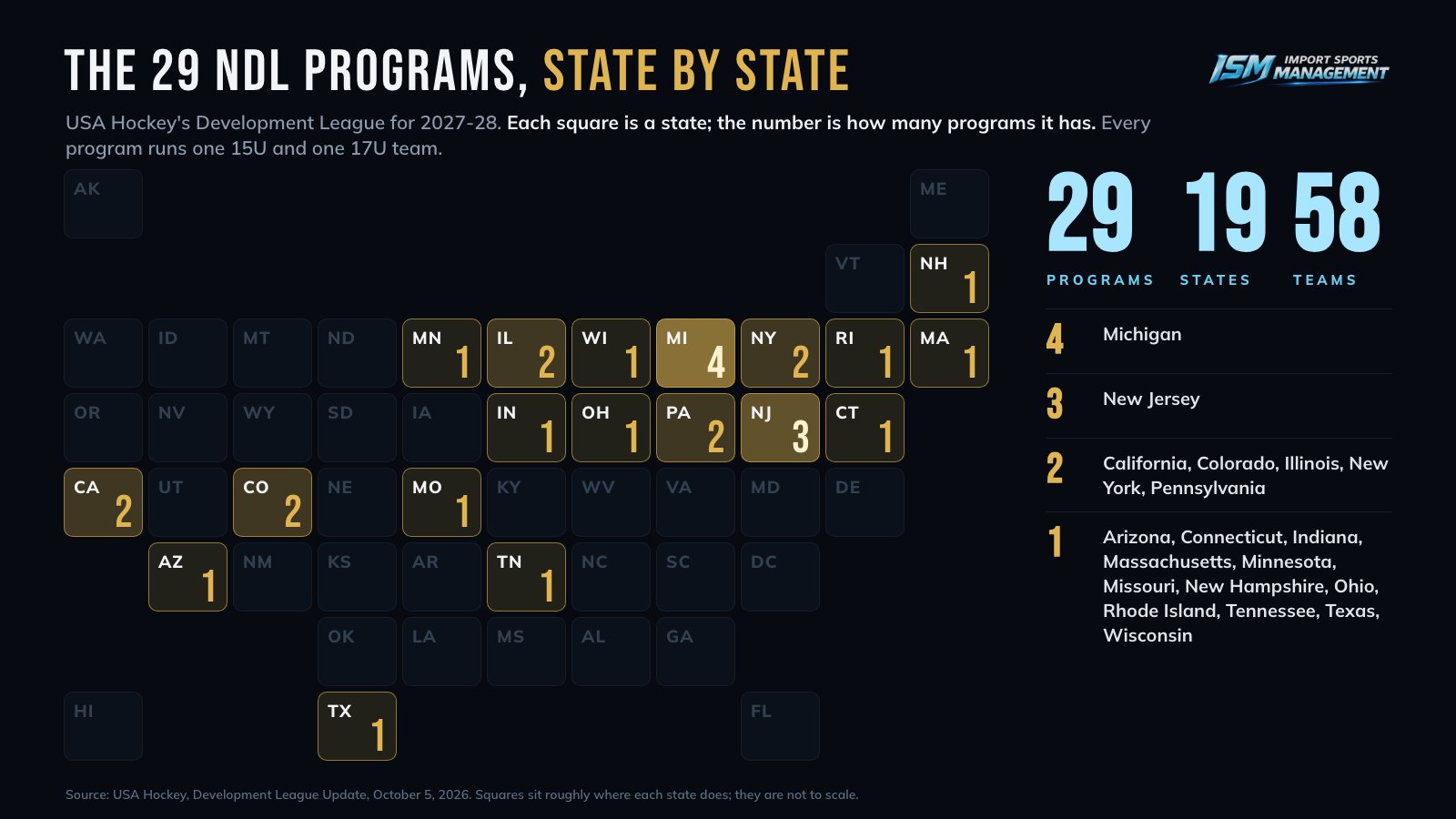
| State | Programs | Which ones |
|---|---|---|
| Michigan | 4 | Compuware, Fox Motors, HB Hockey Club, Little Caesars |
| New Jersey | 3 | North Jersey Avalanche, Rockets Hockey Club, Wolfpack Hockey Club |
| California | 2 | Anaheim Jr. Ducks, Los Angeles Jr. Kings |
| Colorado | 2 | Colorado Thunderbirds, Okanagan Hockey Colorado |
| Illinois | 2 | Chicago Mission, Reapers Hockey Association |
| New York | 2 | BK Selects, Buffalo Jr. Sabres |
| Pennsylvania | 2 | Philadelphia Jr. Flyers, Pittsburgh Penguins Elite |
| Arizona | 1 | Jr. Coyotes |
| Connecticut | 1 | Mid Fairfield |
| Indiana | 1 | Culver Academies |
| Massachusetts | 1 | Boston Jr. Eagles |
| Minnesota | 1 | Shattuck-St. Mary's |
| Missouri | 1 | St. Louis AAA Blues |
| New Hampshire | 1 | Seacoast Spartans |
| Ohio | 1 | Ohio Blue Jackets |
| Rhode Island | 1 | Jr. Mounties |
| Tennessee | 1 | Nashville Jr. Predators |
| Texas | 1 | Dallas Stars Elite |
| Wisconsin | 1 | Madison Capitols |
A few patterns help a family read the list:
- It is concentrated. Michigan has four programs and New Jersey three; California, Colorado, Illinois, New York and Pennsylvania have two each; the other 12 states have one. There is no program in Florida, in the Pacific Northwest or on the northern plains, which matters because the league's open residency lets a player join from anywhere but does not put a team near him.
- Whole leagues came across. All nine members of the Northeast Pack Hockey League were invited, and 12 of the 29 are listed as members of the Tier 1 Elite Hockey League. The NE Pack has already said it will run 15U DL and 17U DL divisions in 2027-28 with ten full-time teams in each, its nine members plus the Boston Jr. Eagles, and Okanagan Hockey Colorado as a guest. On November 24 it added the Florida Surf, a Tier 1 club that is not in the DL, as a full-time member at 13O and 14U, and said the Surf would join its other age groups if USA Hockey invites the club into the DL, which the guidebook does not allow before 2029-30. On the East Coast, the Atlantic Youth Hockey League will add the Rockets and the Wolfpack for 2027-28, which puts all four DL programs in USA Hockey's Atlantic District in one league, though it has not said whether the DL teams themselves will play its schedule. It has added two more clubs since and now counts 19 associations for that season. Expect much of the "DL schedule" to be existing rivalries under a new name.
- Four are run by schools. Shattuck-St. Mary's in Minnesota and Culver Academies in Indiana are boarding schools; the Jr. Mounties are the hockey academy at Mount Saint Charles Academy in Rhode Island; BK Selects is Bishop Kearney High School's program in Rochester, New York. For those four, the hockey decision is tied to a school decision.
- Several are close to the Canadian border. The Buffalo Jr. Sabres and BK Selects are in western New York, and four programs are in Michigan, three of them around Detroit. That is the group Ontario families will hear about first, and the rules for Canadian players below apply to every one of them.
Membership is not permanent. The guidebook lets the subcommittee audit any program every year, put it on probation and remove it, and a change of ownership or corporate structure triggers a review. In the other direction, no program can be added before 2029-30: USA Hockey will say by August 1, 2028 whether it will expand, take applications that October, and announce any new programs at its January 2029 Winter Meeting.
Which programs have named their NDL coaches?
Thirteen of the 29 had named a general manager or a head coach for their DL teams by November 24, 2026. Each program hires its own staff. The guidebook (section H.2) asks only that every DL team name a head coach and assistant coaches and provide "qualified goaltender coaching and strength & conditioning coaches." The hires so far lean on junior and pro experience. Compuware's general manager, Sean Clark, holds the same job with the USHL's Sioux City Musketeers, and the Madison Capitols' new general manager, Justin Friedman, is the director of scouting for the USHL team of the same name. The Ohio Blue Jackets named Cam Atkinson, who played 13 NHL seasons, associate general manager, and the Reapers' 17U coach, Brett Lebda, played 398 NHL games.
| Program | General manager or lead | Head coaches |
|---|---|---|
| Anaheim Jr. Ducks | Alex Kim, general manager | 17U: Alex Kim 15U: Cory Kane |
| Buffalo Jr. Sabres | Jason Nightingale, general manager | 17U: Jason Nightingale 15U: Jacob Brozyna |
| Chicago Mission | Gino Cavallini, director of DL teams | 17U: Joe Caprio 15U: John Doherty |
| Colorado Thunderbirds | Ryan Seavy, general manager | 17U: Ryan Seavy 15U: Mike Davies |
| Compuware | Sean Clark, general manager | 17U: not named 15U: not named |
| Jr. Coyotes | Ron Filion, general manager | 17U: not named 15U: not named |
| Los Angeles Jr. Kings | Brett Beebe, general manager | 17U: Mark Ferner 15U: not named |
| Madison Capitols | Justin Friedman, general manager and director | 17U: not named 15U: not named |
| Ohio Blue Jackets | Ed Gingher, general manager; Cam Atkinson, associate general manager | 17U: not named (search announced October 27) 15U: Josh Harrold |
| Okanagan Hockey Colorado | Jason Fortier, general manager | 17U: not named 15U: not named |
| Philadelphia Jr. Flyers | Rocky Russo, general manager | 17U: Jon Rogger 15U: Rocky Russo |
| Pittsburgh Penguins Elite | Danny MacKinnon, president | 17U: Dan Mayes 15U: Jerry Freismuth |
| Reapers Hockey Association | Brett Lebda, general manager of the association | 17U: Brett Lebda 15U: Chris Michael |
The general manager is usually the person who answers a family's first email, so the table doubles as a list of who to write to when you are getting on a program's list. If your program is not in it, ask who will coach the team before you sign. A Player Agreement binds a player to his team for the whole season, and a coaching change is not one of the guidebook's three ways out of one (section I.3.d).
Which Birth Years Play 15U and 17U?
In 2027-28, 15U is for players born in 2012 plus up to four born in 2013, and 17U is for players born in 2010 and 2011 plus up to two born in 2012. USA Hockey sets a player's age by how old he is on December 31 of the season, so the 15U team is 14- and 15-year-olds and the 17U team is 15-, 16- and 17-year-olds, with hard caps on the youngest players in each.
| Team | Ages on December 31 | Birth years in 2027-28 | Birth years in 2028-29 | Limits |
|---|---|---|---|---|
| 15U DL | 14 and 15 | 2012, plus up to four 2013s | 2013, plus up to four 2014s | No more than four 14-year-olds, and no more than one of them a goalie. No 13-year-olds |
| 17U DL | 15, 16 and 17 | 2010 and 2011, plus up to two 2012s | 2011 and 2012, plus up to two 2013s | No more than two 15-year-olds, and no more than one of them a goalie. No 14-year-olds |
Every roster holds at most 22 players, 20 skaters and two goalies, and may never drop below 15. Two goalies are mandatory. A program must run both teams; it cannot enter only one age group.
What changes at a DL club is the middle of the ladder. A DL organization "may not field 15O and 16U Tier I teams," so the single-birth-year 15O team and the 16U team disappear at all 29 programs, replaced by 15U DL and 17U DL. A program may still run 13O, 14U and 18U Tier 1 teams, to a maximum of five teams between 13O and 18U. Clubs outside the DL keep 15O and 16U exactly as they are.
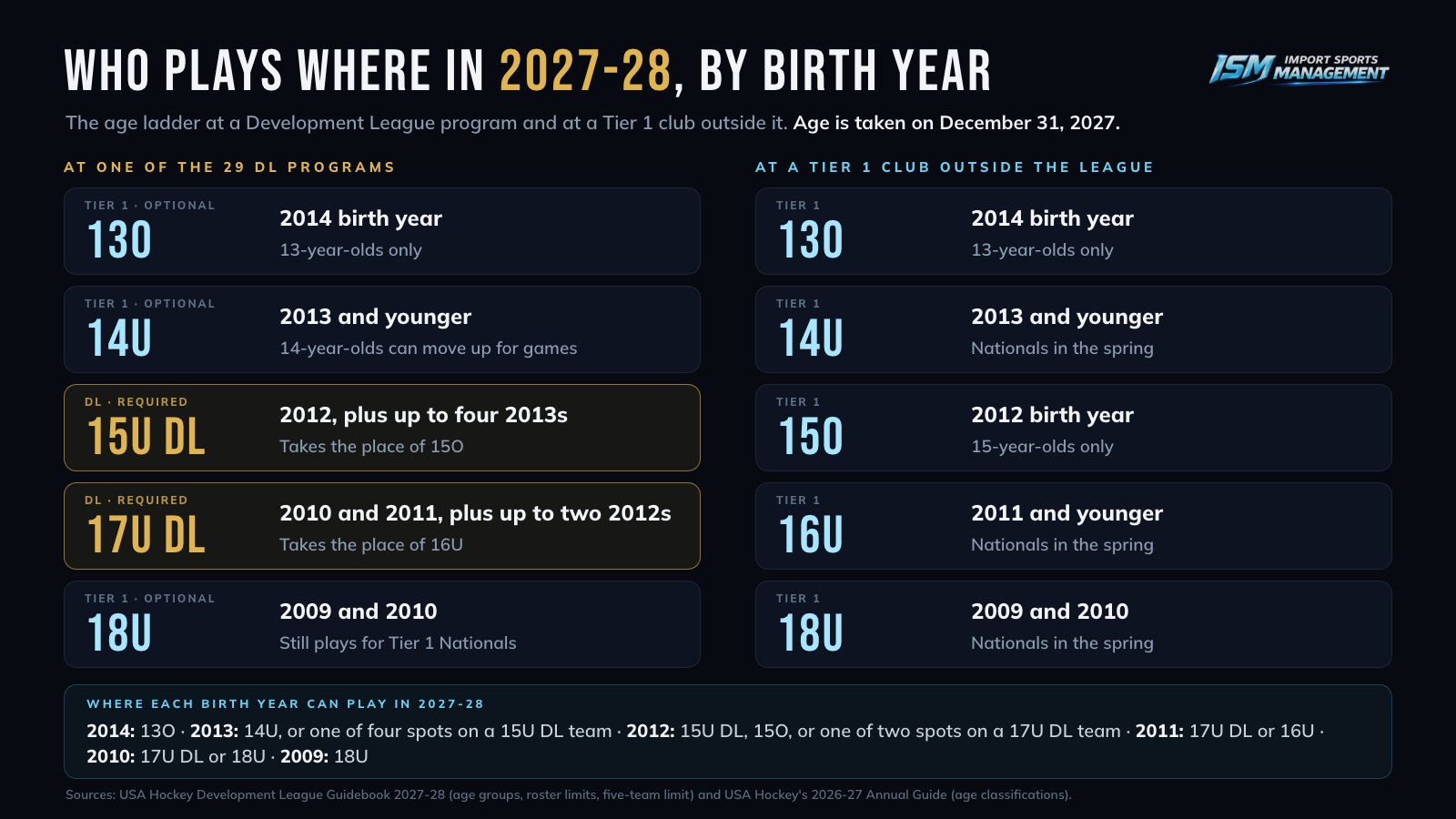
Where each birth year can land in 2027-28:
- 2014. 13O Tier 1. Too young for the DL.
- 2013. 14U Tier 1, or one of the four 14-year-old spots on a 15U DL team. A 14-year-old on a DL club's 14U team can also be moved up to its 15U DL team for games during the season.
- 2012. The core of 15U DL. The strongest can take one of the two 15-year-old spots on a 17U DL team. At a club outside the league: 15O Tier 1.
- 2011. 17U DL, or 16U Tier 1 at a club outside the league. These players go through the USHL's Phase I draft and the OHL Priority Selection in spring 2027, just before the DL's first season.
- 2010. 17U DL, 18U Tier 1, or junior hockey.
- 2009. Too old for the DL: 18U Tier 1 or junior.
The in-season movement is called vertical integration. Between September 1 and February 15, a DL organization may move a 14-year-old from its 14U Tier 1 team up to its 15U DL team, a 15-year-old from 15U DL up to 17U DL, and a 16- or 17-year-old from its 18U Tier 1 team onto its 17U DL team, always one game a day at most. For a strong 2013 or 2012, that reads as the practical route into games a level up without holding one of the capped underage spots. The guidebook does not spell that out, so ask the program how it plans to use it.
How Does an NDL Season Work?
Each team plays 40 to 55 regular-season games between September and March, at least 60 percent of them against other DL teams, on a schedule its own program builds. USA Hockey sets the frame and the minimums; the programs fill in the dates, the opponents and the travel.
| Rule | What the guidebook requires |
|---|---|
| Regular season | 40 to 55 games, September to March (G.2.a, G.2.c) |
| Opponents | At least 60 percent of regular-season games against other DL teams (G.2.b) |
| Practice | A season average of at least three on-ice practices and two off-ice training sessions a week. Team practices may start August 1 (G.1) |
| Staff | A head coach and assistants, qualified goaltending coaching, a strength and conditioning coach, a team manager and at least one locker room monitor (H.2, F.4.g) |
| Game length | Three 20-minute periods, with the ice cleaned between periods (G.4.a, G.4.c) |
| Tie games | In the regular season, five minutes of sudden-death 3-on-3, then a three-player shootout, then a sudden-death shootout (G.4.d). The playoff format is still to come (G.4.e) |
| Points | 3 for a regulation win, 2 for an overtime or shootout win, 1 for an overtime or shootout loss, 0 for a regulation loss (G.5.b) |
| Games per day | One. No DL team or DL player may play more than one game a day (G.2.g) |
| Other teams | A DL player may not be rostered on or play for any other team that season, apart from the three exceptions below (F.1.d) |
| Rosters | Filed with the DL registrar by October 15, or three business days before the first game if that is earlier. No additions after February 15 (F.4.c, F.4.l) |
| Postseason | DL playoffs and a league championship, with the format still to come. No USA Hockey National Championships (G.2.f, Section III.J.5) |
Three of those rules will feel different to a family coming from Tier 1. The one-game-a-day limit ends the tournament weekend as many teams play it now. The training minimum, three practices and two off-ice sessions a week on average, is now a rule a program can be audited on instead of a line in a brochure; our guide to in-season training covers how a teenager holds up under that load. And the single-team rule is strict. The only exceptions in the guidebook are junior games in the USHL or NAHL under USA Hockey's affiliated player policy, games inside the player's own organization under vertical integration, and National Team Development Program competition that the NTDP and the DL team agree on.
Who a team plays depends on where it is. "The teams are all in charge of the scheduling, the costs and the cost structure, who they play, when they play, where they play," Topher Scott of the Hockey Think Tank told the Boston Globe. In the Northeast that should mean short trips: David Hymovitz, the Boston Jr. Eagles' director of hockey operations, told the same paper he expects to play the other New England programs and make day trips or one-night trips to the five in New York and New Jersey. "If this was about getting on flights every weekend, it wouldn't work for anybody," he said. Programs in Dallas, Nashville and Arizona have no such neighbours, and their fact sheets will show it.
Existing leagues are positioning themselves as the scheduling backbone. The Northeast Pack will run 15U DL and 17U DL divisions for ten full-time teams, and it has already published its 2027-28 dates: five showcase weekends between September 24, 2027 and January 23, 2028, in Rochester, Chicago, Pittsburgh, New Jersey and Buffalo, then playoffs in Rochester on February 18 to 21, 2028. Minnesota Hockey has announced two fall series in which it and Shattuck-St. Mary's will host DL teams, the Chicago Mission among them. And on its November 2026 call with the programs, USA Hockey reportedly encouraged them to coordinate across the Northeast Pack and the Tier 1 Elite league, the two leagues that hold most of the DL teams, and to host pods so that one trip covers several games.
The standards reach the bench and the officials too. DL coaches must hold USA Hockey's coaching certifications for the age group and are expected to take part in DL-specific high performance coaching programs. Officials assigned to DL games get video feedback and evaluation, and USA Hockey says it will run its Advanced Officiating Development Program inside the league.
Reported, but not yet confirmed by USA Hockey
Clanko Media reported these details from the league's calls with its 29 programs, in October 2026 and again after the November 17 call. USA Hockey has not published them, so treat each one as likely rather than settled:
- The first championships. Target dates of March 12 to 18, 2028, for both age groups, with round-robin games and then knockout rounds in one area. In October the target was the Detroit area, using USA Hockey Arena in Plymouth and nearby rinks; the league now plans to visit rinks in December before it chooses.
- A September showcase. A league showcase in Rochester, New York in the second week of September 2027, with 16 teams in each age group. Exact dates are pending.
- Scores but no standings. A league website will carry team information, schedules and scores, but USA Hockey does not plan to publish official standings.
- No high school hockey on the side. A DL player will not be allowed to play for a high school team at the same time, including in states where high school hockey sits outside USA Hockey.
- No guest members. The 15U and 17U classifications are reserved for the 29 programs, a point USA Hockey repeated in November. DL teams can still schedule outside opponents, but those games do not count toward the 60 percent.
- Twenty-minute periods everywhere. DL teams are to play three 20-minute periods in every game in the United States in 2027-28, including against Tier 1 opponents, which existing tournaments and showcases will have to accommodate. Silver Stick events that teams had already committed to get an exception for the first season.
- A later start for Tier 1 tryouts. USA Hockey's board is due to vote in January on a proposal to open Tier 1 tryouts on the third Monday after Nationals. If it passes, DL programs would have a window to run their own tryouts before families have to commit to a Tier 1 team.
When Do NDL Teams Sign Players, and When Are Tryouts?
Signing for 2027-28 opens on January 15, 2027 for a program's returning players and on February 1 for everyone else, stops on March 1, and resumes with tryouts 48 hours after USA Hockey's National Championships end on April 4. That is the single biggest change for families: the top tier can now fill its rosters two months before any other Tier 1 club is allowed to hold a tryout.
| Date | What happens |
|---|---|
| October 5 to 7, 2026 | USA Hockey names the 29 programs; all 29 accept |
| Winter 2026-27 | Programs take player inquiries, and at least one has announced identification events. Nothing can be signed yet |
| January 15 to 31, 2027 | Early signing period: a DL team may sign its organization's returning players (I.1.a) |
| February 1 to 28, 2027 | Open signing period: a DL team may sign any eligible player (I.1.b) |
| March 1 to April 4, 2027 | Blackout. No tryouts and no signings until Nationals end. One exception: a player whose team has been eliminated from the medal games at Nationals may sign (I.1.c) |
| From about April 6, 2027 | Forty-eight hours after the last game of Nationals, DL teams and Tier 1 teams alike may hold tryouts and sign players. A proposal to open Tier 1 tryouts later is reported to go to a vote in January |
| August 1, 2027 | DL teams may begin practising |
| September 2027 | The first regular season begins. A league showcase in Rochester, New York is reported for the second week of the month |
| October 15, 2027 | Rosters must be with the DL registrar, or three business days before a team's first game if that is earlier |
| February 15, 2028 | Last day to add a player to a roster, and the end of in-season vertical movement |
| March 12 to 18, 2028 | Target dates for the first DL championships, with the Detroit area the front-runner to host (reported) |
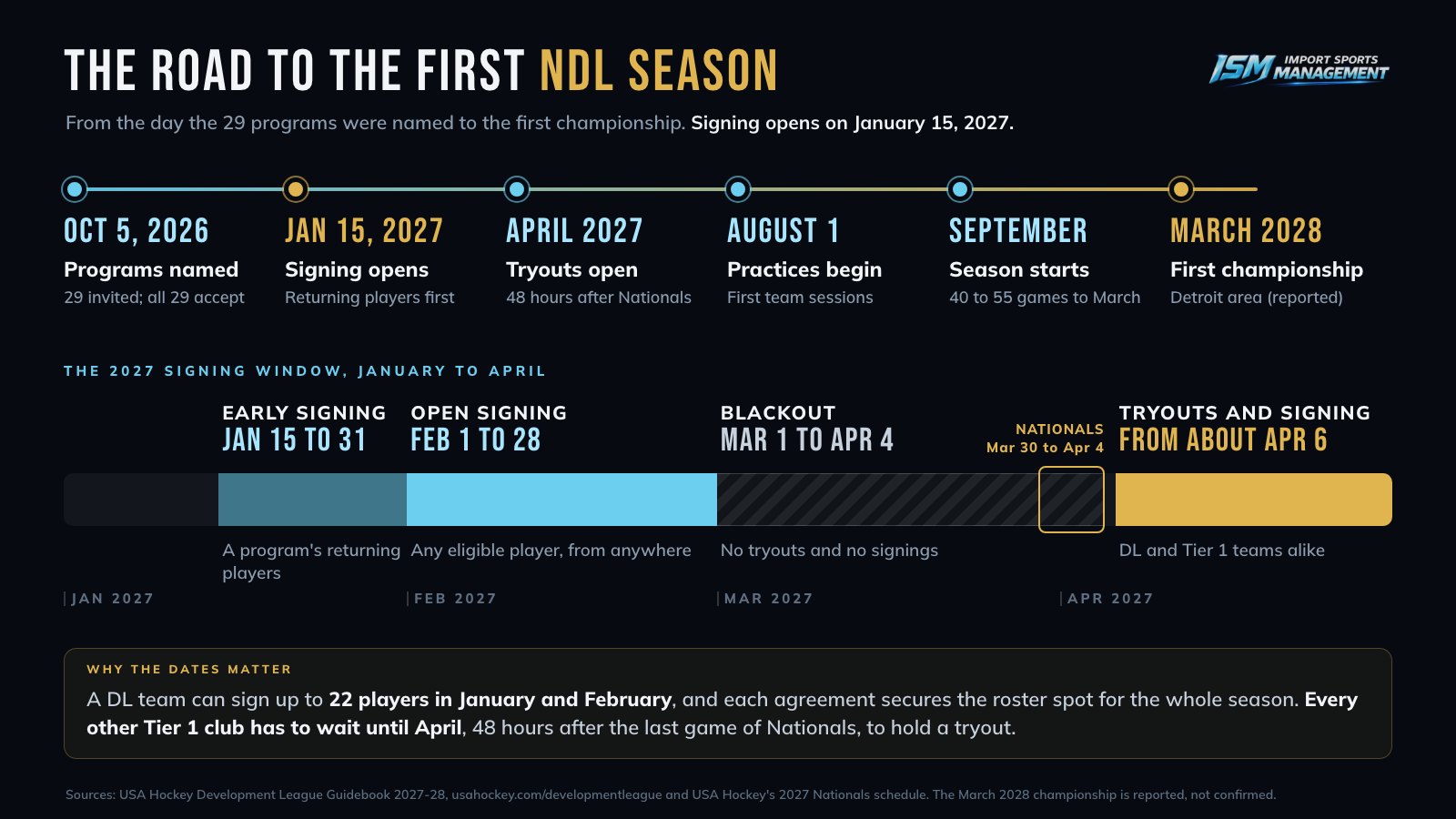
Read the windows carefully, because each one is narrower than it sounds:
- The early window is for players already in the building. The guidebook limits January 15 to 31 to "their organization's returning players." If your player is at one of the 29 programs now, the conversation about next season is a January conversation. Ask the club how it defines returning, especially for a player on its 14U or 16U team today.
- February is the open market. From February 1 a DL team can sign a player from anywhere in the country, because DL teams have open residency. A team may hold no more than 22 signed agreements, and it has to report each signing to the registrar within 24 hours.
- The blackout protects the playoffs, mostly. From March 1 until Nationals finish there are no tryouts and no signings. In 2027 the Tier 1 championships run March 30 to April 4, with 13O and 14U in Plymouth and Novi, Michigan, 15O and 16U in Chicago and 18U in San Jose.
- April is when everyone else catches up. Tier 1 clubs outside the league may not hold tryouts until that same 48-hour mark, so a player who waits for a spring tryout is choosing from whatever DL spots are left. That date could move later still: USA Hockey's board is reported to be voting in January on a proposal to open Tier 1 tryouts on the third Monday after Nationals, which by our count would be April 19 in 2027 and would leave DL programs about two weeks of tryouts to themselves.
Programs are already recruiting ahead of the windows. The Anaheim Jr. Ducks, for one, have opened an interest list, plan identification events this winter and say their main tryout camp will start 48 hours after Nationals. The Los Angeles Jr. Kings have a player inquiry form on their Development League page. Expect the same at most of the 29. Clanko Media, which spent a November weekend at two events in Detroit, described recruiter after recruiter meeting players and parents from the 2011 and 2012 birth years, two months before anything can be signed.
For a family with a foot on each side of the border the calendar creates a real squeeze. Ontario's AAA clubs hold their evaluations in April, as our guide to the GTHL explains, so a DL offer in February has to be answered before the Canadian options exist on paper. The same is true of a prep school decision. If you are going to be in that position, map both calendars now; our recruiting timeline by age shows where these years sit in the longer plan.
How Do You Get on an NDL Team?
By signing a Player Agreement with one of the 29 programs. There is no league draft, no central tryout and no application to USA Hockey: each program scouts, evaluates and signs its own players, so the road runs through the program's hockey director. In order:
- Check the birth year. For 2027-28, 15U takes 2012 birth years and up to four 2013s; 17U takes 2010 and 2011 birth years and up to two 2012s. A goalie must be a US citizen, and a skater who is not needs a previous season on a USA Hockey team.
- Choose programs he could really attend. Open residency means any of the 29 can sign him, but a program two flights away also means a new school and a host family or a dorm. Start with the ones your family could sustain for seven months.
- Get on the program's list now. Several programs already have interest forms on their sites, and at least one has announced identification events for this winter. Check before he skates at one. USA Hockey's rostering policy for Tier 1 teams counts an identification skate with another program as a tryout, and a player signed with a Tier 1 team may not take part in one during the season, which runs until 48 hours after Nationals. The penalty is a suspension of at least five games and 18 months in which he cannot sign or play with that program. Contact about next season is allowed, so write to the hockey director with his birth year, position, current team and a few minutes of recent video. Thirteen programs have named the people running their DL teams; the list is above.
- Ask for the Team Fact Sheet. A program must give you its fees, travel costs, payment schedule and weekly schedule in writing, signed, before it can make an offer. Ask for it early, and compare it with what you pay now.
- Sign in the right window. A program's returning players can sign from January 15 to 31, 2027. Everyone else can sign from February 1 to 28. Whatever is left is filled at tryouts, which may start 48 hours after Nationals end on April 4.
- Finish the registration. Every player registers with USA Hockey and pays its membership fee, the registry has to verify his date of birth and citizenship, and the program must report the signing to the DL registrar within 24 hours. Rosters are filed by October 15.
What to do before January 15 depends on where your player is today:
| If your player | Do this before January 15, 2027 |
|---|---|
| Is at one of the 29 programs, born 2010 to 2013 | Ask the club whether he counts as a returning player, when it will make offers, and for the Team Fact Sheet. His window is January 15 to 31 |
| Plays Tier 1 at a club outside the league | Decide whether a DL program is realistic for school and travel, then contact its hockey director now. His window opens February 1 |
| Is in prep school or high school hockey | Nothing forces a decision: those routes continue. If he wants to look, the February window applies to him too, and he could not play for both |
| Is Canadian, or holds another passport | Check the previous-season rule first. Without a season on a USA Hockey team before 2027-28 he cannot be on a DL roster that season. The season now under way, 2026-27, counts |
| Is a goalie who is not a US citizen | Look elsewhere: prep school, a Tier 1 club outside the league, or 18U |
| Was born in 2014 | Nothing yet. He is too young for 2027-28; his first DL season would be 2028-29, as one of the four 14-year-olds on a 15U team |
What Does a Player Agreement Commit a Family To?
A Player Agreement binds the player to one DL team, and that team to the player, for the entire season; before it can even be offered, the team must hand the family a signed Team Fact Sheet that lists the fees and the schedule. The agreement is the heart of the system, and it cuts both ways.
Families at Tier 1 clubs will recognise most of it. USA Hockey's rostering policy for Tier 1 teams, set out in its Annual Guide, already requires a signed Team Fact Sheet before any offer and a Player Agreement that binds both sides for the season, with the same 18-month penalty for trying out elsewhere. Three things are different in the DL. The signing comes earlier: a Tier 1 club may not offer next season's agreement until 48 hours after Nationals, while a DL team can sign in January and February. The exits are narrower: a Tier 1 agreement does not stop a player leaving for Tier 2, high school, junior or college hockey, while the DL's release rule names only the NTDP, the USHL and the NAHL. And disputes go to the DL commissioner instead of USA Hockey's affiliates.
What you must be given first. The Team Fact Sheet has to include, at a minimum:
- the specific DL team the player will be rostered on;
- the anticipated fees for the season: team fees, uniform and equipment fees, anticipated travel costs for the player, any required travel for the parents, and anything else that is a condition of playing;
- the payment schedule or payment options;
- the planned number and weekly average of practices, games and off-ice sessions;
- any player or parent code of conduct; and
- an acknowledgment, signed by the team and the parents, that both are bound by the fact sheet and the agreement.
What the agreement gives you. A secured roster spot. The guidebook says the agreement "binds the signing team to that player and secures a roster spot on a specific team for the entire playing season." A team cannot sign 25 players and cut to 22 in September.
What it takes away. The freedom to keep shopping. While the agreement is in force a player may not attend a tryout for any other team or program, with three named exceptions: the NTDP, the USHL and the NAHL. A signed player who tries out for another DL or Tier 1 program becomes ineligible to sign or play with that program for 18 months. A player who leaves his DL team during the season and tries to join another DL or Tier 1 team cannot be rostered there for the rest of that season or the next one. The agreement does not hold a player in three cases: the team and the player agree to a release, the team releases him for breaking the agreement or its code of conduct, or a USA Hockey grievance hearing finds that the team broke SafeSport or other policies in a way that justifies his release.
The junior exits. If a player signs with the NTDP or with a USHL or NAHL team before his DL team's first game, the DL team must release him "without any financial penalty." After the first game he can still go, but he must settle what he owes the DL team or agree a figure in writing, and the commissioner can rule if the two sides disagree.
The CHL is not on that list. The guidebook names three destinations, and the Canadian Hockey League is not one of them. Read plainly, that means a player who signs a DL agreement and then decides to report to an OHL, WHL or QMJHL team is not covered by the no-penalty release, and a CHL camp could be treated as a tryout with another team. According to reporting by Clanko Media, relayed in Full Ice's DL tracker, USA Hockey has told programs that each one will decide for itself whether its players may attend camps run by junior teams outside USA Hockey. USA Hockey has not published that guidance. For any player who has been drafted by a CHL team or expects to be, get the club's answer in writing before you sign, and read our pieces on the CHL and NCAA routes and the OHL draft first.
Eight questions to ask before you sign
Put these to the program's hockey director, and ask for the answers in writing:
- The paper. May we have the Team Fact Sheet now, and the full Player Agreement to read at home before the signing window opens?
- The real number. What is the all-in cost per month, and what is not in it: flights, hotels, parents' travel, housing, school, equipment?
- The exits. What do we owe if he leaves after the first game for the USHL, the NAHL or the NTDP? What if a CHL team calls?
- The camps. May he attend a USHL, NAHL or CHL camp next summer while he is signed with you?
- The travel. Of the 40 to 55 games, how many are flights, how many nights away, and how many school days does the schedule cost?
- The staff. Who are the head coach, the goalie coach and the strength coach, and are they signed for 2027-28?
- The age spot. If he would be one of the four 14-year-olds on 15U or one of the two 15-year-olds on 17U, what is the plan for his ice time?
- Home and school. If he would move to play, where does he live, who screens the host family, and which school does he attend?
Download the NDL Family Checklist (PDF, one page): the dates, the Team Fact Sheet items, these eight questions and the rules that bind a signed player, on a single sheet to print and bring to the meeting.
What Protections Do Players and Families Have?
Several, in writing: fees disclosed before any offer, a secured roster spot, a free exit to junior hockey before the season starts, background screening for team staff and host families, and a commissioner who can rule on a dispute. The first two are not new: USA Hockey's rostering policy already requires them at every Tier 1 club. Each one comes from the guidebook, with its section number:
- Disclosure before commitment. No offer without a signed Team Fact Sheet listing the fees, the travel and the weekly schedule (I.2.e).
- A secured roster spot. The agreement binds the team as well as the player, for the whole season (I.2.a).
- A free exit to junior hockey. A player who signs with the NTDP, the USHL or the NAHL before his DL team's first game is released without financial penalty (I.1.d).
- Screened adults. Every team must list a team manager and at least one locker room monitor with current background screening and SafeSport training (F.4.g). Coaches, managers, monitors and every adult in a billet home need the same (H.2.b), and each program must sign USA Hockey's SafeSport agreement by September 1 (L.1).
- A cap on the workload. One game a day at most, and no more than 55 regular-season games (G.2).
- A way out if the team breaks the rules. If a USA Hockey grievance hearing finds that the team or its coaches violated SafeSport or other policies, the agreement does not stop the player from signing with another DL or Tier 1 team (I.3.d).
- Somewhere to take a dispute. Disagreements over a Player Agreement go to the DL commissioner, with a right of appeal to USA Hockey's National Appeals Committee (Section III.J.6).
- Oversight of the program itself. USA Hockey can audit a program every year, put it on probation and remove it from the league (E), and a place in the league is not guaranteed from one year to the next (N).
Two things we could not find in the guidebook: what happens to a signed player if his program is removed from the league, and what a family is owed if a program's fees change after the Team Fact Sheet is signed. Ask both questions before you sign.
What Does It Cost to Play in the NDL?
There is no league price. Each program sets its own fees, and the only figure USA Hockey has published is an assessment of $5,500 per team for 2027-28, which works out to $250 a player on a full 22-player roster. Spread over 12 months that is about $21 a month, the smallest line on the bill. The assessment pays for league operations, the playoffs and championship, and development resources for players and coaches. Everything else is the program's to cover and to charge for: the guidebook says DL teams "are responsible for their own operational costs (travel, coaching, ice cost, game officials, equipment, and apparel, etc.)."
| Cost | Who sets it | What is known |
|---|---|---|
| League assessment | USA Hockey | $5,500 per team for 2027-28, paid by the program: about $250 a player on a full roster |
| USA Hockey membership | USA Hockey and the state affiliate | Every player and coach registers and pays the individual membership fee, plus any affiliate fee |
| Team fee | The program | Ice, coaching, officials and staff. Must appear on the Team Fact Sheet |
| Uniform and equipment | The program | Must appear on the Team Fact Sheet |
| Travel | The program | Anticipated travel for the player, and any travel the parents are required to make, must appear on the Team Fact Sheet |
| Housing and school | The family, the program or the school | Only if the player moves to play: a billet fee, or boarding tuition at a school-based program. Not set by the league |
What a family will actually pay is not yet known. When we last checked, on November 24, 2026, Full Ice, which tracks the 29 programs' announcements, had still not found a published DL fee at any of the 15 programs it had profiled; its own checks are dated October 26 and November 12. For a sense of scale, the scouting service Neutral Zone estimates that families outside Minnesota already spend roughly $1,700 to $4,200 a month, or $20,000 to $50,000 a year, at the competitive AAA level. The cost of the DL "is not yet determined," it wrote, "but it's safe to assume it's going to be a lot." It also makes the fair point that these programs already travel heavily and already play each other, so the league may move the bill less than the map suggests.
The first numbers to surface are second-hand. On November 18, 2026, Clanko Media relayed a social media post describing a meeting with an unnamed Midwest program: an estimated $16,000 in team fees plus $7,000 to $9,000 for the player's travel. That is roughly $1,900 to $2,100 a month, or $23,000 to $25,000 a year, before school, housing or the parents' own travel, and it sits inside Neutral Zone's range. Treat it as one program's estimate, passed along twice, not as a price list. On the league's November call, the same report says, USA Hockey told programs to tie any price increase to improvements in what families get.
Four things will separate one program's number from another's:
- Geography. A program with four or five DL opponents inside a day's drive can reach 60 percent on buses and day trips. A program in Texas, Tennessee or Arizona cannot, and a 40-game minimum against mostly DL teams means flights.
- Housing and school. Open residency means many rosters will include players who moved to play. A boarding school bundles room, board and classes into tuition; a club that uses host families adds a monthly billet fee and a school to arrange. The guidebook requires every adult in a billet home to have a current background screen and SafeSport training.
- Staff. The league requires qualified goaltending coaching and strength and conditioning coaches, and expects coaches to take part in its high performance programs. Full-time staff is the standard the Jr. Ducks have already advertised for their two teams.
- Ice. Three practices a week and 20-minute periods use more ice than most Tier 1 teams buy now, and tournament operators who lengthen games for DL teams may pass that on. The league has reportedly told programs to play that format in every game in the United States, not only against each other.
The protection is the Team Fact Sheet. No DL team may offer an agreement until it has given the family that sheet, signed, with the season's fees, the payment schedule, the anticipated travel costs for the player and any travel the parents are required to make. Compare sheets, not sales pitches, and ask for the monthly figure. A Tier 1 club owes you the same sheet under USA Hockey's rostering policy, so the two can be set side by side. Our guide to what junior and college hockey really costs shows where these years fit in the longer budget.
Can a Canadian Play in the NDL?
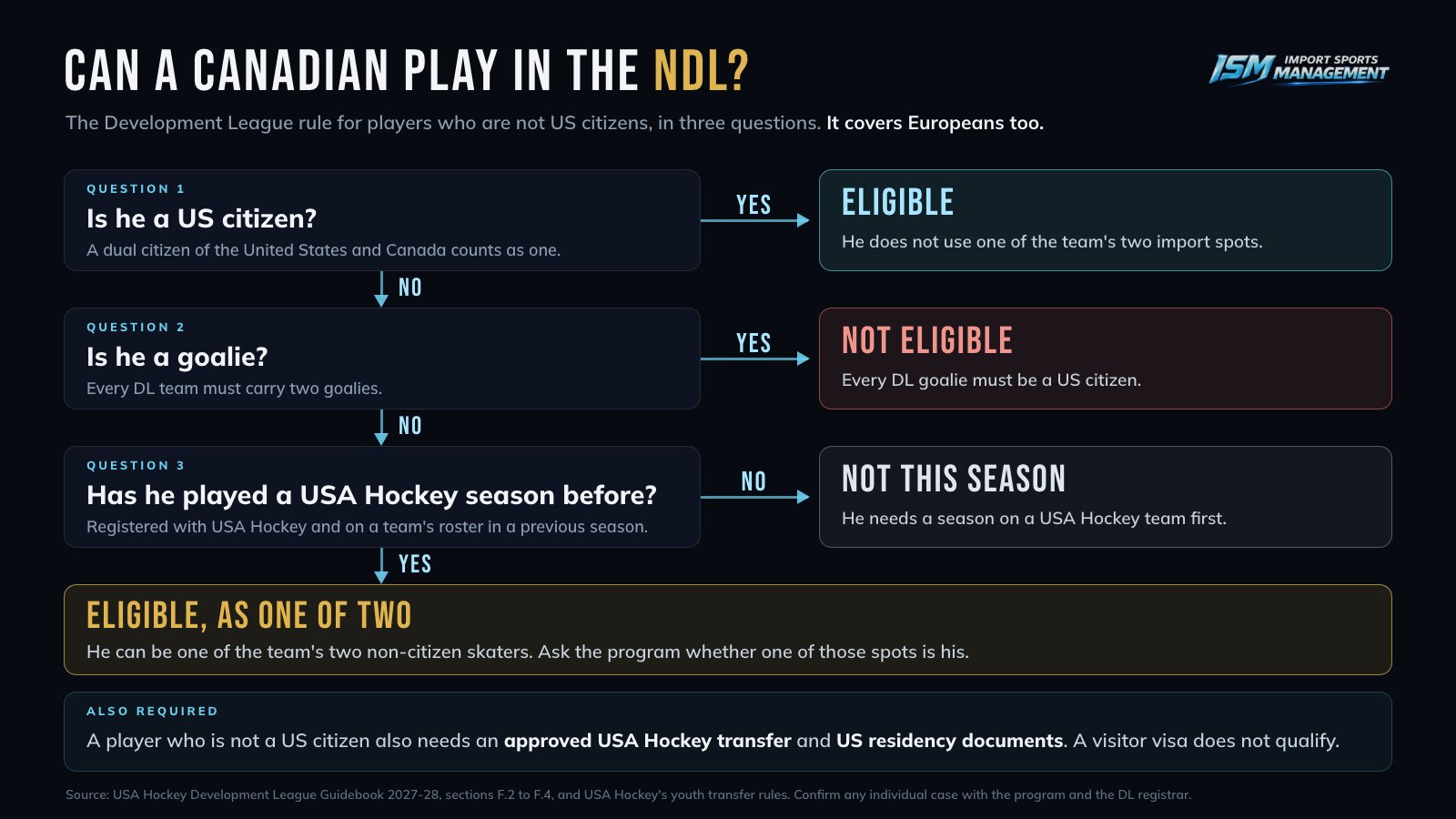
Yes, but only as one of two non-US citizens on a team, only as a skater, and only after a previous season on a USA Hockey team. In rink language, each team gets two imports. A Canadian goalie cannot play in the league at all. The guidebook's wording is the same for both age groups: a DL team "may roster and play up to two (2) non-US citizens" (excluding goaltenders, "who must be US citizens"), provided each has "previously been registered with USA Hockey and played on a USA Hockey team during a previous season."
That one sentence sorts Canadian players into very different situations:
| The player | Can he be on a DL roster? |
|---|---|
| Canadian citizen who has never played on a USA Hockey team | Not that season. He needs a previous season on a USA Hockey roster first. A Tier 1 team qualifies, including a DL club's own 13O, 14U or 18U team |
| Canadian citizen with a past season on a USA Hockey team | Yes, as one of the team's two non-citizen skaters, with an approved transfer and US residency documents |
| Canadian goaltender | No. Every DL goalie must be a US citizen, whatever his history |
| Dual citizen of the United States and Canada | Yes, and he does not use one of the two spots, because he is a US citizen. USA Hockey verifies citizenship in its registry before a player is rostered, and a dual citizen who last played in Canada still goes through the transfer agreement between USA Hockey and Hockey Canada |
| Player from Europe or anywhere else outside North America | The same rule: one of the two spots, skaters only, with a previous USA Hockey season. His transfer runs under the IIHF's rules instead of the Hockey Canada agreement |
| Canadian citizen with a US green card | On the plain wording he still counts as one of the two. USA Hockey's own transfer page says a permanent resident card "does not change a player's citizenship" |
For most Canadian families this is a tighter door than the one it replaces. Under USA Hockey's general rule for Tier 1, set out in the citizenship section of its 2026-27 Annual Guide, a national-bound youth team may carry up to four non-citizens who are in the country on student and similar visas, and players who live in the United States with a parent on a green card or a work visa are not counted against that four. The DL allows two, of any status, and no goalies. And at the 29 DL programs, the 15O and 16U Tier 1 teams where a Canadian 15- or 16-year-old would have played no longer exist.
The practical consequences:
- Plan a year ahead. A 2012-born Canadian skater who wants a 15U DL spot in 2027-28 has to have played on a USA Hockey team in 2026-27, the season now under way, or earlier. A 2013-born who wants one in 2028-29 needs a USA Hockey season behind him by then, and 2027-28 on a DL club's 14U Tier 1 team is the obvious way to get it.
- Ask how the two spots are used. Programs that have long recruited from Canada and Europe now have two non-citizen spots on each DL team. Ask the club directly whether your player would be one of them, and whether that is written into the agreement.
- Goalies need another route. A Canadian goaltender who wants to develop in the United States at 15 or 16 is looking at prep school, a Tier 1 club outside the league, or 18U, not the DL.
- The transfer still comes first. None of this replaces the paperwork. Any player who is not a US citizen needs an approved USA Hockey transfer before he can play, and that includes green card holders. USA Hockey's Canadian youth transfer form requires the player to be living in the United States with one of a list of residency documents (a visitor visa does not qualify) and a release or letter of good standing from his last Canadian club. There is no fee, processing takes about three to five business days, and a transfer for a player without a green card lasts one season.
- Sixteen and under, moving without a parent. Hockey Canada treats this as an appeal, not a routine transfer. Its information package for parents, which Hockey Eastern Ontario still publishes, says "transfers are only granted where there are unique circumstances involved," and a denied appeal means the player returns to his home branch. Apply early.
Our Northeast Pack guide walks through the transfer and appeal steps in more detail, since nine of the 29 DL programs play in that league. If you are weighing a move south for a 2012 or 2013 birth year, this is the conversation our family advisors have with parents every week: which season has to be spent where, what the club will put in writing, and what the Canadian options look like on the same dates.
Why Did USA Hockey Create the NDL?
USA Hockey says its best 14- to 17-year-olds had no clear path, and that a smaller group of programs held to common training standards will send better-prepared players to the USHL, the NAHL and the national teams. Where high school or prep hockey leads, Mancini said, the path is clear; the gap was in the regions built on Tier 1 club hockey. The federation's FAQ describes the goal as making sure players "receive optimal training and competition, ultimately strengthening the overall player pool for junior and college hockey."
There is a second reason that USA Hockey's documents do not mention: Canada. Since August 1, 2025, playing in the Canadian Hockey League no longer costs a player his NCAA Division I eligibility, and American teenagers have moved north in numbers the sport has not seen before.
- The CHL went from about 100 American players in 2024-25 to more than 200, the Boston Globe reported.
- A record 49 Americans were selected in the 2026 QMJHL draft, by Elite Prospects' count as reported by CBC News. Sixty-two were taken in the WHL's 2026 prospects draft, and 79 in the 2025 OHL Priority Selection, up from 33 the year before.
- The traffic runs both ways. There were 628 Canadians on NCAA Division I men's rosters in 2025-26, according to Sportsnet, the most in records that go back to 2003-04.
Neutral Zone, which scouts both countries, calls slowing that exodus the league's "unwritten" objective, noting that USA Hockey's announcement does not mention the CHL. The detail families should notice is in the guidebook itself: the release rule names the NTDP, the USHL and the NAHL, and leaves out the CHL. Our piece on the CHL to NCAA wave has the wider picture.
The league has real arguments in its favour, and Neutral Zone's analysis lays them out. The best programs will play each other more often and lopsided games less. The training minimums and the game cap replace a calendar that rewarded volume. And the age rules create something American youth hockey has not had at scale: a way for an exceptional 14-year-old to play against 15-year-olds, and an exceptional 15-year-old against 17-year-olds, before he has to prove himself in junior.
It also has critics. One coach from a program that was not selected told Neutral Zone that USA Hockey is "solving a problem that doesn't exist." Clanko Media, which interviewed most of the invited programs, called the field strong and the selection process opaque, because USA Hockey has not explained how it weighed results, history, facilities and geography. And nobody yet knows what happens to the families priced out by national travel, or to the Tier 1 clubs that lose their best 2010 to 2013 birth years every February. Cost is already the loudest worry: when Clanko Media spoke to about three dozen parents of 2011 and 2012 birth years at two Detroit events in November 2026, it reported that cost came up more than anything else, and that few of them had been given a firm total.
| The case for the NDL | The case against |
|---|---|
| The best programs play each other more often, with fewer lopsided games | Twenty-nine programs in 19 states leave whole regions without a local option |
| Training minimums and a 55-game cap replace a calendar that rewarded volume | National travel and relocation can price a strong player out |
| An exceptional 14- or 15-year-old can play up against older players | Tier 1 clubs outside the league may lose their best players every February |
| Every team must provide goaltending coaching and a strength and conditioning coach | USA Hockey has not explained how it chose the 29, and a place in the league can be taken away |
| One guidebook and one commissioner, where there were many leagues and many rule sets | Signing in January forces a decision before prep school and spring options are known |
What Happens to Tier 1, Prep School and High School Hockey?
Tier 1 continues, with its leagues and its national championships, but the 29 DL programs give up their 15O and 16U Tier 1 teams, and the strongest players born from 2010 to 2013 can now be signed before any other club is allowed to hold a tryout. USA Hockey's position is that the DL is "one of several pathways" and that players in Tier 1, high school, prep school and Tier 2 "will continue to have opportunities to advance."
- At a DL program. 15U DL and 17U DL replace 15O and 16U. The program can keep 13O, 14U and 18U Tier 1 teams, and those teams still play for Tier 1 district and national championships.
- At a Tier 1 club outside the league. Nothing in the rules changes. The 15U and 17U classifications belong to DL teams only, so these clubs keep 15O and 16U, hold tryouts 48 hours after Nationals under the current rule, and still compete for USA Hockey's national championships, which the DL teams cannot enter.
- Prep school. New England prep hockey is far bigger than the DL's footprint in the region. The Boston Jr. Eagles' David Hymovitz put it in numbers for Clanko Media: about 1,200 boys at more than 60 prep schools, against roughly 80 roster spots at the two traditional split-season programs that were invited. "The kids that are in prep schools, are they really going to leave prep school to do this?" he asked in the Globe. The traffic may even run the other way: many of the parents of 2012 birth years that Clanko Media spoke to at a Detroit tournament in November 2026 said they were planning on New England prep school for next season, or seriously considering it. Our piece on prep school vs AAA at 14 covers that fork.
- High school. A DL player cannot be on a second team, and the league has reportedly told its programs that this includes high school teams. In states where good players have done both, that is now a choice.
- Minnesota. Only Shattuck-St. Mary's was selected from the state with the most NCAA Division I men's players (217 in 2026-27, by Minnesota Hockey's count), and Minnesota Hockey answered within a day. From 2027-28 its CCM Fall High Performance program will centralize two teams of 15s and two of 17s in Blaine each fall, Minnesota residents only, to play DL programs, Shattuck and others before the players go back to their high school and community teams, with a proposed cap of 55 games across the whole year.
- Girls. There is no girls' Development League, and USA Hockey says none is needed for now.
Being left off the list is not a verdict on a club or a player. More than 50 programs applied and were not chosen; the Boston Globe named Masters Academy and Lovell Academy in Massachusetts among them, and Clanko Media called Sioux Falls Power and Philadelphia Hockey Club the two omissions it found hardest to accept. Scouts will still watch those teams, and junior drafts still pick from them.
Where Does the NDL Lead?
To junior hockey, by design: the DL exists to feed the USHL, the NAHL and USA Hockey's National Team Development Program, with college hockey after that. Its rules are built around those three destinations and keep the door to each one open during the season.
| Level | Who plays | What it is |
|---|---|---|
| Tier 2 youth | Travel players at every age | Competitive club hockey below AAA |
| Tier 1 youth (AAA) | 13O to 18U | The top club level, and still the top at 13O, 14U and 18U and at every club outside the league |
| Development League (NDL) | 15U and 17U at 29 programs | The new tier above Tier 1, designed for the top 2 percent |
| NTDP | Under-17 and Under-18 | USA Hockey's own national teams in Plymouth, Michigan |
| USHL and NAHL | Mostly 16 to 20 | Tier I and Tier II junior hockey, the step before college |
| NCAA | College players | Division I and III college hockey, then the pros |
- The NTDP. USA Hockey's national program picks its Under-17 team each spring from players in their 15-year-old season. A DL player who signs with the NTDP before his DL team's first game is released without penalty, and DL players may take part in NTDP competition during the season if the two teams agree.
- The USHL. The league's Phase I draft each May is for 16-year-olds: 2011 birth years in 2027, 2012s in 2028. Under USA Hockey's affiliated player policy, players in their 16-, 17- and 18-year-old seasons can play junior games while staying on a youth roster, and the Nashville Jr. Predators have already told families that their 17U DL players will be eligible for USHL and NAHL call-ups.
- The NAHL. The Tier II league adds players through tenders and its own draft. Our guide to US junior hockey pathways explains how the tiers fit together and why a draft pick is a right, not a roster spot.
- The CHL. Nothing in the DL stops an OHL, WHL or QMJHL team from drafting a DL player, and they will. Which Canadian league holds a player's rights depends on the state he lives in, not the state his program is in: New England is QMJHL territory, most states east of the Mississippi fall to the OHL and most of the West falls to the WHL, as our Northeast Pack guide sets out. A New York player at a Connecticut program is still in the OHL's draft. What changes is the paperwork once a player has signed a DL agreement, described above.
- College. NCAA Division I coaches cannot start recruiting conversations until January 1 of grade 10, and a player can write to them before that. Our guide on how to email college hockey coaches has the rules and the templates.
Two cautions. A DL roster spot is a platform, not a promise: no junior team is required to draft from the league, and by Neutral Zone's rough projection the best players will leave it for junior hockey at 16 and 17, which is the point of it. And a player outside the league is not invisible. Minnesota high schools, New England prep schools and strong Tier 1 clubs have sent players to the same drafts for decades, and USA Hockey itself says they will keep doing so.
What Is Still Not Decided?
Quite a lot. The playoff format, the schedule, what programs will charge and several rules the guidebook leaves open were all unsettled on November 24, 2026. The list, so you know what a program cannot yet tell you:
- The playoffs. The guidebook says only that the structure "will be released at a later date." The reported plan is championships on March 12 to 18, 2028, with the site to be chosen after the league visits rinks in December.
- The schedule. Programs build their own, and the first season's schedules are still to come. The Northeast Pack has published its dates, and a league showcase is reported for September 2027 in Rochester, New York.
- The fees. No program we could find had published what a DL season will cost a family. The only numbers so far come from one social media post about one program's estimates.
- Who will coach most of the teams. Thirteen of the 29 programs had named DL staff by November 24, 2026, and only seven had named both head coaches.
- When Tier 1 tryouts open. Today the rule is 48 hours after Nationals for DL and Tier 1 teams alike. A proposal to open Tier 1 tryouts on the third Monday after Nationals is reported to go to USA Hockey's board in January.
- Who counts as a returning player. The January window is limited to an organization's returning players, and the guidebook does not define the term for the league's first season.
- Camps with teams outside USA Hockey. Whether a signed player may attend a CHL camp is reportedly being left to each program.
- Standings. The league reportedly plans to publish scores but not official standings.
- Next season's league fee. The assessment each team pays is set year by year and announced by January 1.
- Expansion. USA Hockey will say by August 1, 2028 whether it will add programs for 2029-30.
We will update this guide as each one is settled.
How Does the NDL Compare With Tier 1, Prep School and Canadian AAA?
The NDL is the most regulated of the four: fixed training minimums and a cap on games, on top of the signed fee sheet and full-season commitment that US Tier 1 also requires, in exchange for the earliest decision date and the tightest limit on non-American players. For a family choosing among them, the differences are mostly about when you must decide, what is promised in writing and who can play.
| NDL (15U and 17U DL) | US Tier 1 (15O and 16U) | Prep school | Canadian AAA | |
|---|---|---|---|---|
| Who sets the rules | USA Hockey directly, through one guidebook and a commissioner | USA Hockey's districts and affiliates, plus the club's league | The school and its athletic conference | Hockey Canada, the provincial branch and the league |
| When you decide | January 15 to February 28, then again after Nationals in April | Tryouts from 48 hours after Nationals in April | The school's admissions calendar, the winter before | Spring evaluations; April in Ontario |
| The commitment | A Player Agreement for the full season, with limits on leaving for another DL or Tier 1 team | Also a Player Agreement for the full season, under USA Hockey's rostering policy for Tier 1 teams; it does not block a move to Tier 2, high school, junior or college hockey | Enrolment and tuition for the school year | Registration with one team; releases are governed by the branch |
| The season | 40 to 55 games, September to March, one game a day, three practices a week | Set by the club and its league, often around showcase weekends | A school-term season, with club hockey in the fall for many players | A weekly league schedule from fall, with playoffs in spring |
| The championship | DL playoffs and championship | USA Hockey district and national championships | Conference and league championships | League, provincial and regional championships |
| Costs in writing | Required: a signed Team Fact Sheet before any offer | Also required: USA Hockey's rostering policy for Tier 1 teams calls for a signed Team Fact Sheet before any offer | Published tuition, with financial aid at many schools | League and association fees are published; team budgets vary |
| Non-citizen players | Two per team, skaters only, each with a prior USA Hockey season | Up to four on student-type visas on a national-bound team; transfer required | Set by the school; a USA Hockey transfer where the team is registered with USA Hockey | For an American heading north, Hockey Canada's transfer rules apply |
| Built to feed | The USHL, the NAHL and the NTDP | The same junior leagues, and Tier 1 Nationals exposure | NCAA programs, directly and through junior | The OHL, WHL and QMJHL, then the NCAA or U SPORTS |
None of these is the path. A 2012-born American defenceman at a DL program has a different best answer from a 2012-born Canadian forward in Ottawa whose family is looking south, and the right answer often changes once between 14 and 16. The useful question is not which league is best. It is which one puts your player on the ice, in the right role, in front of the people who decide his next step, at a cost and a distance your family can sustain. Our guides to the Northeast Pack and the GTHL show what the season looks like on each side of the border.
How ISM approaches this: We do not steer families toward a league or a logo. We map the player's options against the calendar, the drafts, the school situation and the budget, then make the calls. With the NDL that means knowing which programs are strong at his birth year and how they plan to use their underage and non-citizen spots, reading the Team Fact Sheet and the Player Agreement before anything is signed, and lining up the Canadian, prep and junior options that fall on the same dates. If January 15 is on your mind, talk to a family advisor before the signing window opens, not after it.
Terms Used in This Guide
The words that come up in every conversation about the new league, defined the way USA Hockey's guidebook and rulebook use them:
- USA Hockey Development League (DL or NDL)
- USA Hockey's national tier for 15U and 17U players, starting in 2027-28 with 29 programs. DL is the official short form; NDL, for National Development League, is the name many clubs and parents use for the same league.
- 15U DL
- A Development League team of 14- and 15-year-olds, by age on December 31 of the season. No more than four 14-year-olds and no 13-year-olds. In 2027-28 that means 2012 birth years plus up to four 2013s.
- 17U DL
- A Development League team of 15-, 16- and 17-year-olds. No more than two 15-year-olds and no 14-year-olds. In 2027-28 that means 2010 and 2011 birth years plus up to two 2012s.
- Tier 1 (youth)
- USA Hockey's top youth classification outside the Development League, usually called AAA. It is a different ladder from Tier I junior hockey, which is the USHL.
- 15O and 16U
- The Tier 1 age groups for 15-year-olds only (15O) and for 16 and under (16U). A Development League organization may not field either one. Clubs outside the league still do.
- Player Agreement
- The written agreement that binds a player to one DL team, and the team to the player, for the whole season. It must be signed before a player can be rostered, and a team may sign no more than 22.
- Team Fact Sheet
- The signed disclosure a DL team must give a family before it can offer a Player Agreement: the specific team, the fees, anticipated travel costs, the payment schedule, the weekly schedule and any codes of conduct.
- Early signing period
- January 15 to 31. The window in which a DL team may sign its own organization's returning players for the following season.
- Open signing period
- February 1 to the end of February, and again from 48 hours after the last game of Nationals. The window in which a DL team may sign any eligible player.
- Blackout period
- March 1 until the USA Hockey National Championships end. No tryouts and no signings, except for a player whose team has been eliminated from the medal games at Nationals.
- Open residency
- The rule that a DL team may roster a player wherever he lives, with no state, district or affiliate boundary.
- Vertical integration
- Moving a player up within his own organization for games between September 1 and February 15: a 14-year-old from 14U Tier 1 to 15U DL, a 15-year-old from 15U DL to 17U DL, or a 16- or 17-year-old from 18U Tier 1 to 17U DL.
- Affiliated player
- A youth player who plays junior games in the USHL or NAHL under USA Hockey's Youth/Junior Affiliated Player Policy while staying on his youth roster. DL players are allowed to do this.
- Team assessment
- The annual fee each DL team pays the league, $5,500 for 2027-28. It funds league operations, the playoffs and development resources. It is not the fee a family pays.
- Non-US citizen rule
- A DL team may roster at most two players who are not US citizens. They must be skaters, and each must have been registered with USA Hockey and played on a USA Hockey team in a previous season.
- Transfer (USA Hockey and Hockey Canada)
- The approval a Canadian citizen, or a dual citizen moving from Canada, needs before playing for a USA Hockey team. It requires US residency documents for a player who is not a US citizen and, for a player coming from a Canadian club, a release or letter of good standing.
- NTDP
- USA Hockey's National Team Development Program in Plymouth, Michigan, home of the national Under-17 and Under-18 teams. It is not the same thing as the NDL.
- USHL and NAHL
- The Tier I and Tier II junior leagues in the United States. The Development League is built to prepare players for both, and its release rule names them along with the NTDP.
- USA Hockey Nationals
- The National Championships for Tier 1 and Tier 2 youth teams, held in late March and early April. DL teams do not take part, and tryouts and signing reopen 48 hours after the last game.
- Import
- Rink language for a player who is not a citizen of the country he plays in. In the Development League an import is any non-US citizen, from Canada, Europe or anywhere else, and each team may roster two.
- Billet
- A host family that houses a player who has moved away from home to play. The Development League requires every adult in a billet home to have a current background screen and SafeSport training.
- American Development Model (ADM)
- USA Hockey's framework for age-appropriate training and competition, introduced in 2009. USA Hockey describes the Development League as the next step after the National Team Development Program and the ADM.
- DL registrar
- The USA Hockey official who approves every DL roster and player move. Teams must report a signing within 24 hours and file their rosters by October 15.
Sources
- USA Hockey. USA Hockey Development League. The league page: definition, the 29 programs, the top 2 percent target, training and schedule standards, the timeline, and what families are promised.
- USA Hockey. Development League Guidebook, 2027-28 Season (PDF). The binding rules: governance, selection criteria, expansion, age groups and roster limits, the non-US citizen rule, vertical integration, season and game format, the $5,500 assessment, signing periods, Player Agreements and the Team Fact Sheet.
- USA Hockey. USA Hockey Development League Update: Selected Programs Announced, Commissioner and Registrar Named. October 5, 2026. The 29 invited programs by state; more than 80 applicants; Scott Paluch named commissioner and Erin Mensay registrar.
- USA Hockey. USA Hockey Development League Update: All 29 Selected Programs Accept Invitation to Join DL. October 7, 2026. Confirmation that every invited program accepted.
- USA Hockey. USA Hockey Winter Meeting Focused on Advancing Sport. January 22, 2026. The USA Hockey Congress approved the Development League at the Winter Meeting that concluded January 18, 2026 in Nashville.
- USA Hockey. Frequently Asked Questions: The USA Hockey Development League (DL). Not a league in the traditional sense; designed to work in cooperation with Tier 1; why 15U and 17U; why there is no girls' league; the NTDP and American Development Model lineage.
- USA Hockey. Annual Guide, 2026-27. Rules and Regulations Section III.J (Development League); the Tier I Player Rostering Policy in Section III.B (Player Agreements, Team Fact Sheets and what counts as a tryout at Tier 1 clubs); the 15U DL and 17U DL age classifications; the citizenship eligibility rule for youth teams, including the limit of four student-visa players on national-bound teams; the Youth/Junior Affiliated Player Policy.
- USA Hockey. Youth Hockey Transfer Forms. Who needs a transfer, the USA Hockey and Hockey Canada transfer agreement, green cards and limited transfers, processing times.
- USA Hockey. 2026-27 Canadian Youth Written Transfer Form (PDF). Acceptable US residency documents, the visitor-visa exclusion, the release or letter of good standing from a Canadian club, no fee, three to five business days.
- USA Hockey. 2027 National Championship Schedule. Youth Tier 1 championships March 30 to April 4, 2027 in Plymouth and Novi, Chicago and San Jose, which set the end of the signing blackout.
- Anaheim Jr. Ducks. USA Hockey selects Jr. Ducks for elite National Development League. October 6, 2026. Use of the names National Development League and NDL; teams based at Great Park Ice in Irvine; full-time staff; winter identification events; tryout camp 48 hours after Nationals.
- Philadelphia Jr. Flyers. Philadelphia Jr. Flyers Selected for USA Hockey Development League. October 13, 2026. The club's reference to its NDL 15U and 17U teams.
- Pittsburgh Penguins Elite. Pittsburgh Penguins Elite to Join USA Hockey National Development League. October 9, 2026. Use of the name USA Hockey National Development League.
- Los Angeles Jr. Kings. Los Angeles Jr. Kings Hockey Club Announces Inclusion in USA Hockey Developmental League. October 5, 2026. Headquarters at the Toyota Sports Performance Center in El Segundo; the club's Development League player inquiry form; Brett Beebe listed as DL general manager and Mark Ferner as 17U head coach.
- Phoenix Jr. Coyotes. Phoenix Jr. Coyotes Accepted into USA Hockey Development League for Inaugural 2027-28 Season. October 7, 2026. The program's base at the Ice Den Scottsdale.
- Philadelphia Jr. Flyers. Philadelphia Jr. Flyers Announce NDL Coaching Leadership. October 19, 2026. Rocky Russo named NDL general manager and 15U head coach; Jon Rogger named 17U head coach.
- Buffalo Jr. Sabres. Nightingale & Brozyna Named First DL Coaches. October 27, 2026. Jason Nightingale, the program's general manager, named 17U head coach and Jacob Brozyna 15U head coach.
- Nashville Jr. Predators. Nashville Jr. Predators Selected to Join USA Hockey Development League (DL) for Inaugural 2027-28 Season. October 16, 2026. The club's statement that its 17U DL players will be eligible for USHL and NAHL call-ups.
- Chicago Mission. 2027-28 Coaching Staff: USA Hockey Development League. October 28, 2026. Joe Caprio named 17U head coach and John Doherty 15U head coach, with Gino Cavallini as director of the club's DL teams.
- Anaheim Jr. Ducks. Anaheim Jr. Ducks announce coaching and player development staff for NDL. November 16, 2026. Alex Kim named Development League general manager and 17U head coach, Cory Kane 15U head coach and Craig Johnson director of coaches.
- Pittsburgh Penguins Elite. DICK'S Sporting Goods Pittsburgh Penguins Elite Announces Leadership and Coaching Staff for USA Hockey Development League 15U and 17U Teams. November 18, 2026. Dan Mayes named 17U head coach and Jerry Freismuth 15U head coach; Danny MacKinnon listed as president.
- Phoenix Jr. Coyotes. Announcing USA Hockey Development League Leadership. November 21, 2026. Ron Filion named general manager of the 15U and 17U DL teams, Mike DeAngelis vice president of hockey operations and Jordan Muzzillo assistant general manager.
- Ohio Blue Jackets. Ohio Blue Jackets announce leadership team for USA Hockey Development League. October 27, 2026. Ed Gingher named general manager, Cam Atkinson associate general manager and Josh Harrold 15U DL head coach; an outside search for the 17U head coach.
- Colorado Thunderbirds. Development League Leadership Team Announced. October 27, 2026. Ryan Seavy named general manager of the Development League teams and 17U head coach; Mike Davies named 15U head coach.
- Reapers Hockey Association. Reapers Announce their USA Hockey DL teams head coaches (PDF). Brett Lebda, the association's general manager, named 17U head coach and Chris Michael 15U head coach.
- Compuware Youth Hockey. Compuware Names Sean Clark Development League General Manager. Sean Clark named general manager of the club's Development League program.
- Okanagan Hockey Colorado. USA Hockey DL (15U/17U). The club's Development League staff, with Jason Fortier as general manager.
- Madison Capitols. Madison Capitols Announce Justin Friedman as General Manager and Director of USA Hockey DL Program. November 24, 2026. Justin Friedman, the director of scouting for the USHL's Madison Capitols, hired as general manager and director of the club's 15U and 17U Development League programs.
- Northeast Pack Hockey League. NE Pack Announces Addition of Boston Jr. Eagles at 15U DL & 17U DL ~ 27-28 Season. October 19, 2026. The league's 15U DL and 17U DL divisions, ten full-time teams in each, with guest teams anticipated.
- Northeast Pack Hockey League. Little Caesars AAA Hockey Club Expands Northeast Pack Hockey League Commitment ~ 2027-2028 Season. October 7, 2026. All nine NE Pack member organizations were invited into the Development League.
- Northeast Pack Hockey League. Okanagan Hockey Colorado Named As Official Guest Organization at 15U & 17U DL ~ NE Pack 27-28 Season. October 28, 2026. Okanagan Hockey Colorado as the league's guest organization at both DL age groups.
- Northeast Pack Hockey League. The Northeast Pack Hockey League Announces 2027-2028 Schedule. November 4, 2026. The league's 2027-28 dates and sites: five regular-season showcases for its 14U, 15U, 17U and 18U divisions, an optional October showcase, and playoffs on February 18 to 21, 2028 in Rochester, New York.
- Northeast Pack Hockey League. NE Pack Welcomes Florida Surf as Exclusive Southeast District Organization. November 24, 2026. The Florida Surf join at 13O and 14U from 2027-28; the league says the club would join its other age groups if USA Hockey invites it into the Development League.
- Atlantic Youth Hockey League. Tier I AAA Rockets & Wolfpack Join AYHL & AMHL Launches New Tier II League. November 13, 2026. The Rockets Hockey Club and the Woodbridge Wolfpack join the league for 2027-28, so all four Development League programs in USA Hockey's Atlantic District will be part of it.
- Atlantic Youth Hockey League. Tier I AAA AYHL Expands Again for 2027-2028 Season with Addition of Red Bank Generals. November 20, 2026. The league's count of 19 associations for its Tier 1 season in 2027-28.
- Tier 1 Elite Hockey League. League Members. The member list checked on November 24, 2026: 12 of the 29 Development League programs appear on it.
- Minnesota Hockey. Minnesota Hockey Announces New Boys CCM Fall High Performance Program. October 6, 2026. Two teams of 15s and two of 17s centralized in Blaine each fall, Minnesota residents only; a proposed 55-game cap; two fall series hosting Development League teams; 217 Minnesotans in NCAA Division I men's hockey.
- The Boston Globe. Four New England youth programs selected for new USA Hockey Development League. October 5, 2026. By Matt Porter. Bob Mancini's remarks; the selection factors; the plan for 32 programs; home bases of the four New England programs; Masters Academy and Lovell Academy not selected.
- The Boston Globe. If all goes to plan, new USA Hockey Development League will have larger impact on colleges than prep schools. October 12, 2026. By Matt Porter. Topher Scott and David Hymovitz on scheduling, travel and prep school; Americans in the CHL rising from about 100 to more than 200.
- Neutral Zone. USA Hockey's Development League: An Analysis of its Objectives and Impact. October 7, 2026. The case for and against the league; the estimate of $20,000 to $50,000 a year at competitive AAA levels; the projection of how many players leave for junior hockey at 16 and 17.
- Clanko Media. USA Hockey's DL: A Strong Field, an Opaque Process. October 8, 2026. Interviews with most of the invited programs; the 19-state footprint; the programs left out; David Hymovitz's prep school numbers.
- Clanko Media. USA Hockey's DL Takes Its Next Step. October 22, 2026. Reported details from the league's first call with its programs: the March 2028 championship in the Detroit area, no official standings, no high school teams, no guest members, 20-minute periods against outside opponents. Not confirmed by USA Hockey.
- Clanko Media. "I Can't Afford Your Dream" The Race for a Spot in USA Hockey's Development League. November 18, 2026. Reported details from the league's November 17 call with its programs: target dates of March 12 to 18, 2028 for the first championships, a September 2027 showcase in Rochester, the DL game format in every US game, and a January vote on Tier 1 tryout dates. Also a social media post's account of one program's fee estimates, and what parents said at two Detroit events. Not confirmed by USA Hockey.
- Full Ice. Development League Tracker. Updated November 18, 2026. The running log of program announcements; its 15 linked program pages report no published DL fee (checks dated October 26 and November 12, 2026); the reported guidance that each program decides whether its players may attend outside junior camps.
- Sportsnet. Prospects Report: Why CHL teams keep pushing for American players. June 12, 2026. By Mike Koreen. 628 Canadians on NCAA Division I men's rosters in 2025-26; the rise in American players in the CHL.
- CBC News. 'Everything changed': A wave of U.S. hockey talent is taking the QMJHL route. June 13, 2026. By Ethan Hunt. A record 49 Americans in the 2026 QMJHL draft by Elite Prospects' count; 62 in the WHL prospects draft; 79 in the 2025 OHL draft, up from 33.
- College Hockey Inc. NCAA DI Council Votes to Make CHL Players Eligible. November 7, 2024. CHL players eligible for NCAA Division I hockey from August 1, 2025.
- United States Hockey League. USHL Draft Set for May 4-5. April 28, 2026. Phase I is the draft for the 16-year-old age category.
- Western Hockey League. Kelowna Rockets to select first overall in 2026 WHL Prospects Draft. March 2026. The WHL sets draft eligibility by where a player resides, and lists the provinces and US states in its territory.
- Hockey Eastern Ontario. Inter-Branch / USA Hockey / International Transfer Appeals: A Guide for Parents and Team Officials (PDF). Hockey Canada's appeal requirements for players 16 and under moving to the United States without their parents.
Last reviewed November 24, 2026. The league's rules, dates, fees and program list were checked against the sources above on that date. The playoff format, the 2027-28 schedule and each program's fees had not been published, and the details reported from the league's calls with its programs had not been confirmed by USA Hockey. Program home bases are from each program's own site or announcement, or from the Boston Globe for the four New England programs. Confirm anything that matters for your player with the program, the DL registrar, or your advisor.